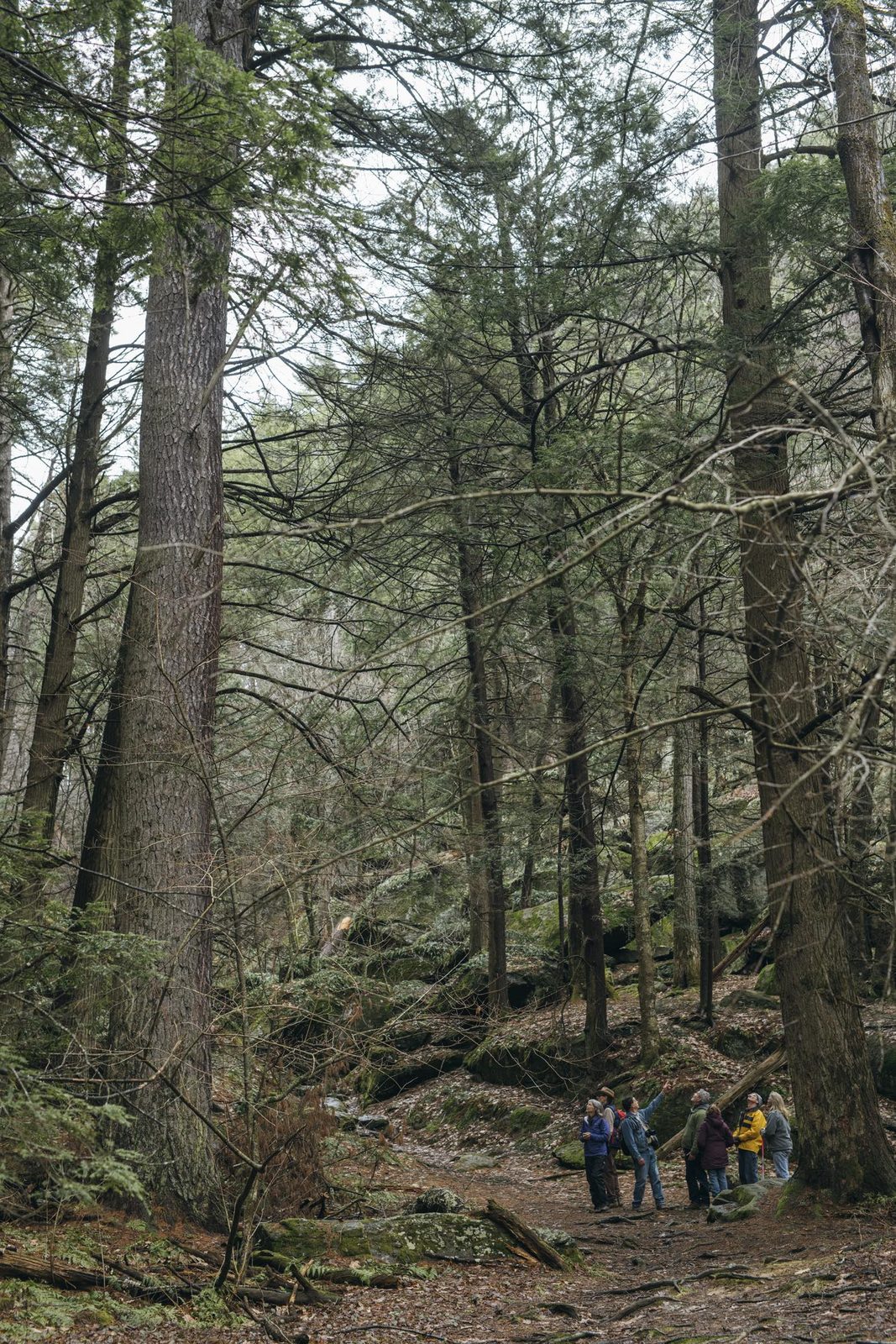
Ice Glen is a deep, boulder-strewn ravine in Stockbridge where cold air lingers among the rocks so long that ice can survive into summer. Its shaded slopes shelter some of the last old-growth hemlock and white ash in Massachusetts — never logged, and in places three and four centuries old.
Ice Glen in Stockbridge is a glacial ravine that has moved from 19th-century curiosity to cherished town landmark, and it now also serves as a place to recognize Mohican homelands through new Wa’thatinik signage and related activities.
Origins and geology
Ice Glen is a narrow, mossy ravine filled with massive boulders left by the last ice age, whose crevices can hold ice and snow well into late spring and even early summer. The stones act as natural insulation, creating cool drafts of air that made the site famous locally as a natural refrigerator on hot days. Today the ravine is recognized as a rare remnant of old-growth forest in New England, with tall hemlock and pine rising above the rock walls.
Nineteenth-century use
The first documented excursion through Ice Glen dates to 1841, when Dr. Samuel Parker led a group of boys on a nighttime walk whose icy gusts extinguished their torches and left a deep impression on local imaginations. Visitors soon followed, including Nathaniel Hawthorne, whose wife Sophia described watching torchbearers emerge from the ravine like “a host of stars” spilling out of the dark. Many historians also connect the place to Herman Melville’s reference to an “Icy Glen” in a passage of “Moby-Dick,” helping fix Ice Glen in the broader literary landscape of the Berkshires.
Field donation and civic improvements
In 1891, legal reformer David Dudley Field Jr., long associated with Stockbridge, donated roughly 40 acres containing Ice Glen to the town, securing it as a public landscape rather than private estate ground. With funds from Laurel Hill Association founder Mary Hopkins Goodrich, a metal bridge over the Housatonic River was installed in 1895 to give townspeople safer, easier access; this was later replaced by the suspension footbridge and stone arch used today. The Laurel Hill Association, founded in the 1850s and often cited as the nation’s oldest village beautification society, still cares for the property and maintains the trail network linking Laurel Hill, Ice Glen, and Laura’s Tower.
Civic procession and community traditions
By the later 19th and early 20th centuries, Ice Glen became the centerpiece of an annual torchlight procession, now one of Stockbridge’s signature traditions. Participants in costume walk from town, cross the river, and thread through the ravine by torchlight before gathering around a bonfire for stories and refreshments, an event that has shifted between summer dates and autumn/Halloween but retained its basic ritual shape. Over time footings, railings, and simple steps were added in the roughest spots so that a broader range of residents and visitors could take part in this procession through the rocks.
Present-day trail and activities
Today, Ice Glen is a short but challenging hike starting from near Park Street in the village center, crossing the Goodrich footbridge, and then climbing into the boulder field via a marked trail. Visitors experience scrambling over and between enormous rocks, cool air flowing from crevices, views of old pines and hemlocks, and at the north end a flat rock face bearing an inscription from Field; at the south end stands a pine often described as among the tallest in Massachusetts. The ravine now figures in guided walks such as Housatonic Heritage hikes that retrace the day in 1850 when Melville and Hawthorne combined a Monument Mountain ascent with a visit to Ice Glen, connecting literature, geology, and local history.
Conservation focus
Because Ice Glen’s forest includes unusually old trees for southern New England, Stockbridge has worked with foresters and scientists to identify and protect its old-growth stands. Recent efforts have used GPS mapping and arborist surveys to document individual trees and plan responses to invasive pests, underscoring how the site’s cultural story now includes ecological stewardship as well.
Wa’thatinik signage and Mohican presence
Long before it was called the Berkshires, the Mohican people knew this land as Wa’thatinik — “The Land Beyond the Mountains.” In recent years, Stockbridge has begun placing new signs bearing the Mohican word “Wa’thatinik” to honor the Stockbridge-Munsee Band of Mohican Indians and their enduring relationship to this homeland. A 2024 dedication highlighted these signs as part of a broader movement to incorporate Indigenous language on public signage, echoing similar dual-language efforts in New England and other states that seek both to educate visitors and to support language revitalization. At Ice Glen and nearby sites, the Wa’thatinik markers frame the ravine not just as a picturesque New England curiosity but as part of a longer Mohican story on the Housatonic, inviting hikers, heritage-walk participants, and torchlight-parade goers to recognize that they move through an Indigenous landscape as well as a geological one.
The dedication, in full
Wa’thatinik. Please, say it with me: Wa’thatinik. Translated, it means, ‘the Land Beyond the Mountains.’ What the ancient voices named this place we now know as the Berkshires.
It may be hard for some of us to imagine, but for time immemorial Mohican was the language of these lands. Beyond this bridge lies an ancient forest now known as Ice Glen, so old that its same trees were already mighty when Chiefs Konkapot and Umpachene welcomed white settlers with some trepidation nearly 300 years ago.
Wa’thatinik. The words encourage us to imagine a time in this place when the forests were stewarded rather than owned. They encourage us to imagine a time in this place when we only took what was needed and gave thanks every day for that which was taken.
If these oak and hemlock and pine could talk, they might tell the story of Mohican and settler walking these same paths. Learning each other’s words and ways in the newly founded “Indian Town”. They might recount a time when Konkapot and John Sergeant together walked these woods. They would perhaps remind us to once again listen to one another, to shine a light in this modern world through a lens of timeless wisdom.
Wa’thatinik is but a fragment of the many words of these ancient, old growth woods. If the forest could speak, the stories it might tell. We are honored to take this moment to once again speak this phrase of the common tongue when these trees were young.
Many of us hope that, going forward, as our Mohican friends share with us their timeless wisdom, we will together become better stewards of the rivers, meadows, lakes, and forests of Wa’thatinik — this beautiful ‘Land Beyond the Mountains’.
Thank you.
— Patrick White